Policy to Industry: Decoding Regulatory Impact
Finance Tips
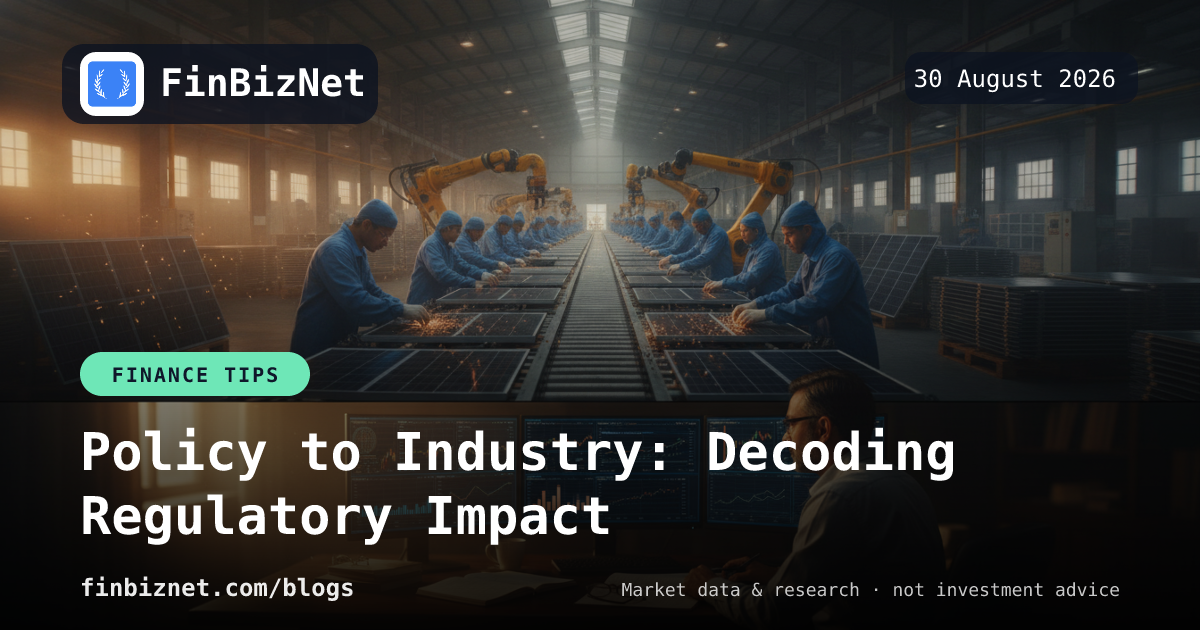
The Indian economy is a dynamic ecosystem, constantly shaped by a confluence of factors. Among the most influential are government policies and regulatory shifts. For any market participant, understanding how these announcements translate into tangible impacts on industries and individual companies is crucial for informed analysis. This article delves into the mechanics of how policy announcements move industries, providing a framework for observing these shifts.
At its core, a policy announcement often signals a change in the operating environment for specific sectors. Consider a hypothetical "National Infrastructure Development Plan" announced by the government, earmarking a significant outlay of, say, ₹5 lakh crore over five years for projects in roads, railways, ports, and urban development. Such a plan isn't just a headline; it's a blueprint for future economic activity. The mechanism is straightforward: increased government spending in these areas directly translates into higher demand for materials, equipment, and services from companies operating within the infrastructure ecosystem.
The immediate beneficiaries of such a plan would typically include the construction and engineering sector, cement manufacturers, steel producers, and capital goods companies. For instance, a surge in road construction projects would necessitate greater demand for cement and steel, impacting companies involved in their production and supply. Similarly, railway expansion would boost orders for rolling stock manufacturers and signalling equipment providers. Observing the data trail involves tracking government tenders, project awards, and the quarterly results of companies in these segments for indicators like order book growth, revenue expansion, and capacity utilisation. Platforms like FinBizNet's data section can be instrumental in tracking these fundamental shifts.
Key Takeaways
- Government policies and regulatory changes are powerful drivers of industry performance.
- Policy outlays, like a hypothetical ₹5 lakh crore infrastructure plan, directly stimulate demand in specific sectors.
- Observing changes in order books, revenue growth, and capacity utilisation helps gauge policy impact.
- Regulatory bodies like RBI and SEBI shape the operational landscape for financial and capital markets.
The Regulatory Framework: Beyond Government Spending
While fiscal policies involving government spending are significant, regulatory changes by bodies like the Reserve Bank of India (RBI) or the Securities and Exchange Board of India (SEBI) also exert profound influence. For example, if the RBI introduces new lending norms for Non-Banking Financial Companies (NBFCs), perhaps by adjusting capital adequacy requirements or asset classification rules, it directly impacts their operational flexibility and profitability. Such a move could lead to a reassessment of lending strategies by NBFCs, potentially affecting credit availability for certain segments of the economy.
- RBI's influence: Changes in interest rates, liquidity measures, or prudential norms directly affect banks, NBFCs, and the broader credit market.
- SEBI's role: Regulations pertaining to market infrastructure, disclosures, or specific financial products (e.g., mutual funds, IPOs) shape the capital markets and investor participation.
- Sector-specific regulators: Bodies like IRDAI for insurance or TRAI for telecom also introduce rules that can redefine competitive landscapes and business models within their respective industries.
From Macro to Micro: The Ripple Effect
The impact of policies isn't always direct. Sometimes, a macro-level policy can create a ripple effect across multiple industries. Consider a hypothetical government initiative to promote electric vehicle (EV) adoption, offering subsidies for EV purchases and incentives for setting up charging infrastructure. This policy, while directly boosting EV manufacturers, also creates demand for battery producers, charging station developers, power distribution companies, and even raw material suppliers for battery components. The shift encourages innovation and investment across an entire value chain, demonstrating how a single policy can foster new ecosystems and transform existing ones.
Historically, significant policy shifts have often been precursors to multi-year growth cycles for the directly impacted sectors, underscoring the importance of tracking policy developments.
Observing the Data Trail
For the retail reader, the key lies in understanding how to observe these impacts through available data, rather than reacting to headlines. When a policy is announced:
- Identify the direct beneficiaries: Which industries or sub-sectors are explicitly targeted or stand to gain from the policy's provisions?
- Track financial metrics: Look for changes in revenue growth, profit margins, order books, and capital expenditure plans of companies in the identified sectors. These are often reported in quarterly earnings.
- Monitor capacity additions: Companies anticipating increased demand often announce plans for new factories or expanded production lines.
- Analyse regulatory filings: Companies might disclose the expected impact of new regulations or policy benefits in their annual reports or investor presentations.
- Sectoral performance: Observe how sector-specific indices or sub-indices perform relative to the broader market, which can indicate collective sentiment and fundamental shifts. For comprehensive data, exploring resources on FinBizNet can be beneficial.
What to Watch
Upcoming government budget announcements, regulatory reviews by the RBI or SEBI, and new policy frameworks for emerging sectors are crucial events to monitor. These often contain the seeds of future industry shifts and offer early insights into potential changes in the economic landscape.
Explore on FinBizNet
- Data hub — official industry and macro series
Published by FinBizNet Desk — auto-generated from FinBizNet's own market data and exchange filings, reviewed for factual framing. This article is market data and research for educational purposes only; it is not investment advice, a recommendation, or a solicitation to transact. FinBizNet is not a SEBI-registered investment advisor. Please consult a registered advisor before making investment decisions.