Refining Margins Surge 265% as Geopolitical Risks Persist
Market Trends
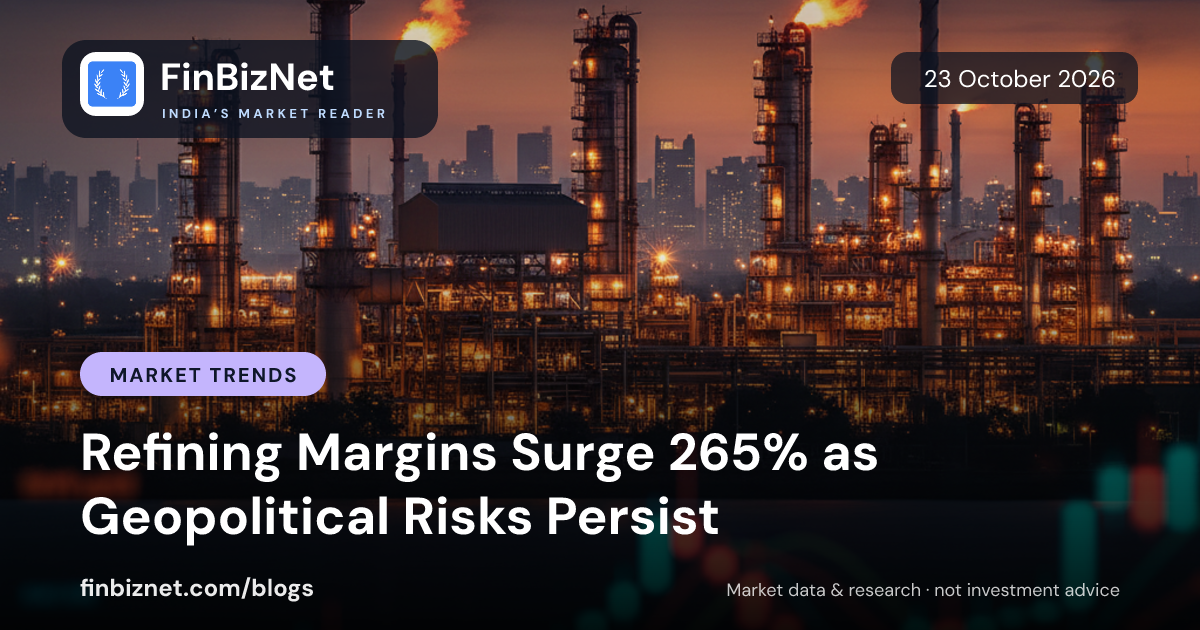
Refining Gross Refining Margins (GRMs) have structurally re-rated to crisis-era levels, validating a positive outlook for Oil Marketing Company (OMC) profitability in the current fiscal year. Research notes received today highlight that Q2 FY27 GRMs surged over 265% year-on-year, driven by elevated crack spreads even as Brent crude prices remained flat throughout October 2026.
The data shows a sharp profit turnaround across the sector. The average 1H FY27 GRM reached $27.9 per barrel, while specific entities like CPCL reported margins of $20.4 per barrel. This expansion is largely attributed to inventory gains contributing US$3.8 per barrel to CPCL’s margins and low-cost inventory utilization at HPCL, which delivered a strong pre-SAED GRM of $32.2 per barrel aided by Vizag RUF utilization.
Despite these refining gains, the marketing segment faces persistent headwinds. LPG under-recovery buffers remain negative, creating a significant offset to upstream profits. For HPCL, the cumulative unrecognised negative LPG buffer stands at Rs18,049 crore. While government compensation for LPG under-recoveries was booked in 1H FY27, the risk remains acute for BPCL, where retail losses and LPG under-recovery caused a Q1 PAT loss of ₹3,960 crore.
Key Takeaways
- Q2 FY27 GRMs surged over 265% YoY, reaching crisis-era highs.
- HPCL reports a pre-SAED GRM of $32.2/bbl supported by low-cost inventory.
- LPG under-recovery buffers remain negative, with HPCL holding Rs18,049 crore.
- Brent crude prices are steady in October 2026, yet margins expand on crack spreads.
Geopolitical Premiums and Supply Normalization
Refiners are currently navigating elevated geopolitical risk premiums in the Strait of Hormuz. Traders remain cautious due to ongoing Houthi attacks and regional energy infrastructure security concerns. However, operational flows have stabilized; India's refiners restored Middle Eastern crude import volumes to pre-conflict levels during September 2026. This normalization allows domestic refineries to process crude more efficiently, though freight costs continue to fluctuate. For instance, ME freight costs doubled quarter-on-quarter for HPCL, impacting margins despite strong refining performance.
Additionally, the Jamnagar refinery complex has drawn US attention for processing Venezuelan crude under changing sanctions regimes. This shift in sourcing adds complexity to supply chains but offers potential cost advantages if regulatory frameworks permit sustained flow.
Refining margins have structurally re-rated to crisis-era levels, validating a positive outlook for OMC profitability.
Company-Specific Dynamics and Catalysts
The research notes provide distinct reads for major players based on their operational focus:
- Hindustan Petroleum Corporation Ltd (HPCL): Delivered strong Q2 FY27 pre-SAED GRM of $32.2/bbl. The Rajasthan Refinery turns PBT positive on volume growth, with a target run rate of 8-9 MMTPA by late Q3 FY27. Polypropylene and DFCU cracker units are scheduled for commissioning in Q4 FY27.
- Bharat Petroleum Corporation Ltd (BPCL): Street estimates point to an EBITDA rebound to around ₹8,000 crore in Q2 FY27, supported by diesel-crack-led GRMs in the $32-40/bbl range. A board meeting on Oct 23, 2026, is expected to confirm these results.
- Reliance Industries Ltd (RIL): Expected to see upside in gas revenue from KG-D6 ceiling of $9.89/MMBtu and elevated O2C refining margins confirmed by sector-wide GRM beats.
- Oil And Natural Gas Corporation Limited (ONGC): Benefiting from Brent crude settling at a five-month high of $113/bbl and unchanged APM gas ceiling of $7/MMBtu, supporting crude realisation at multi-month highs.
- Petronet Lng Limited (Pll): Signed a binding term sheet on Oct 22, 2026, for a 50:50 JV with Gruner Renewable Energy to establish 10 CBG plants, marking its first formal entry into the bioenergy segment.
What to Watch
Investors should monitor the following near-term events detailed in today's notes:
- Oct 23, 2026: BPCL board meeting expected to confirm Q2 FY27 results and EBITDA rebound.
- Oct 24, 2026: BPCL earnings call scheduled to discuss margin sustainability and LPG recovery status.
- Upcoming Results Season: IOCL, MRPL, CPCL, and RIL O2C segment results will confirm whether elevated crack spreads translate to net profit growth after accounting for marketing under-recoveries.
Explore on FinBizNet
- Hindustan Petroleum Corporation — stock page: results, filings, peers
- Oil India — stock page: results, filings, peers
- Bharat Petroleum Corporation — stock page: results, filings, peers
- Petronet Lng — stock page: results, filings, peers
- Oil And Natural Gas Corporation — stock page: results, filings, peers
- Reliance Industries — stock page: results, filings, peers
- Oil and Gas Refining and Marketing — industry page: companies, data, research
- Oil, Gas and Consumable Fuels — industry page: companies, data, research
- Events calendar — results dates, AGMs and policy meetings ahead
Published by FinBizNet Desk. This article is market data and research for educational purposes only; it is not investment advice, a recommendation, or a solicitation to transact. FinBizNet is not a SEBI-registered investment advisor. Please consult a registered advisor before making investment decisions.